How agents can use filesystems for context engineering
By Nick Huang
A key feature of deep agents is their access to a set of filesystem tools. Deep agents can use these tools to read, write, edit, list, and search for files in their filesystem.
In this post, we'll walk through why we think filesystems are important for agents. In order to understand how filesystems are helpful, we should start by thinking through where agents can fall short today. They either fail because (a) the model is not good enough, or (b) they don't have access to the right context. Context engineering is the "delicate art and science of filling the context window with just the right information for the next step". Understanding context engineering - and how it can fail - is crucial for building reliable agents.
A view of context engineering
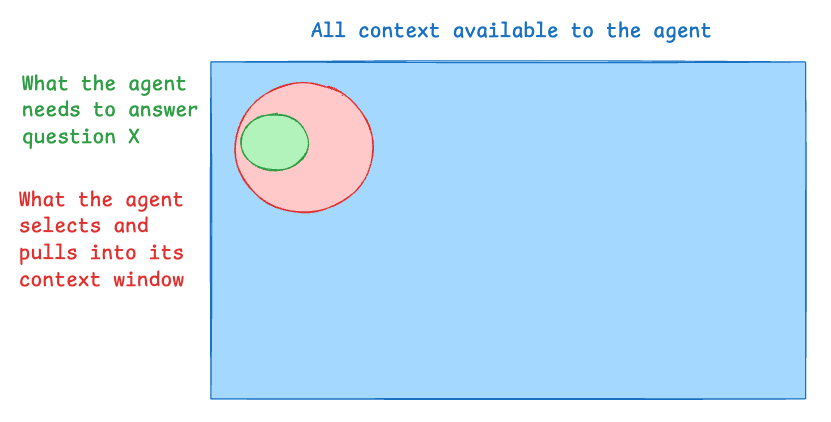
One way to view the job of a modern day agent engineer is through the lens of context engineering. Agents generally have access to a lot of context (all support docs, all code files, etc). In order to answer an incoming question, the agent needs some important context (which contains the context needed to answer the question). While aiming to answer said question, the agent retrieves some body of context (to pull into it's context window).
When viewed from this lens, there are many ways that context engineering can "fail" for agents:
- If the context that the agent needs is not in the total context, the agent cannot succeed. Example: a customer support agent needs access to a certain documentation page to answer a question, but that page hasn't been indexed.
- If the context that the agent retrieves doesn't encapsulate the context that the agent needs, then the agent will not be able to answer correctly. Example: a customer support agent needs access to a certain documentation page to answer a question, that page exists and is indexed, but is not retrieved by the agent.
- If the context that the agent retrieves is far larger than the context that the agent needs, then the agent is being wasteful (with time, tokens, or both). Example: a customer support agent needs a single specific page, and the agent retrieves 100 pages.
Our job as agent engineers is to fit red to green (to make sure that the context the agent retrieves is as small of a superset of the needed information as possible)
Challenges in context engineering
A few specific challenges arise when seeking to isolate the appropriate context:
Too many tokens (retrieved context >> necessary context)
Some tools, like web search, can return a lot of tokens. A few web searches can quickly build up to tens of thousands of tokens in your conversation history. You might eventually run into a pesky 400 bad request error, but well before that, your LLM bill balloons and performance degrades.
Needs large amounts of context (necessary context > supported context window)
Sometimes an agent may actually need a lot of information in order to answer a question. This information usually cannot be returned in a single search query, which is why many have leaned into the idea of "agentic search" - letting an agent call a search tool repeatedly. The issue with this is that the amount of context quickly grows to a point where it can't all fit into its context window.
Finding niche information (retrieved context ≠ necessary context)
Agents may need to reference niche information buried in hundreds or thousands of files in order to handle an input. How can the agent reliably find that information? If it cannot - then the retrieved context will not be what is needed to answer the question. Are there alternatives (or complements) to semantic search?
Learning over time (total context ≠ necessary context)
Sometimes the agent may just not have access to the necessary context for answering a question (either in the tools or instructions it has). The end user may often provide clues (implicitly or explicitly) in their interactions with the agent what that context may be. Is there a way for the agent to add that to its context for future iterations?
How can a filesystem make an agent better?
In the simplest terms: a filesystem provides a single interface through which an agent can flexibly store, retrieve, and update an infinite amount of context.
Too many tokens (retrieved context >> necessary context)
Instead of using the conversation history to hold all tool call results and notes, an agent can write these to the filesystem, and then selectively look up relevant information when necessary. In this example, the agent is effectively using the filesystem as a scratch pad for large context.
Needs large amounts of context
Sometimes agents require a lot of context to answer the question. Filesystems provide a nice abstraction for letting LLMs dynamically store and pull in more information as needed. Examples of this include:
- For long horizon answers, agents need to make a plan and then follow it. By writing that plan to the filesystem, the agent can then pull this information back into the context window later on.
- To pour through all this context, the agent may spin up subagents. As these subagents do work and learn things, rather than just replying to the main agent with their learnings, they can write their knowledge to the filesystem instead.
- Some agents require a lot of instructions on how to do things. Rather than just stuff all these instructions into the system prompt (and bloat context) you can store them as files and let the agent dynamically read them as needed.
Finding niche information
Semantic search was one of the most popular approaches to retrieving context early on in the LLM wave. It can be effective in some use cases, but depending on the type of document (e.g. technical API reference, code files), semantic may be very poorly placed due to a lack of semantic information in the text.
Filesystems provide an alternative to allow agents to intelligently search for context with ls, glob, and grep tools. If you've used Claude Code recently, you'll know that it heavily relies on glob and grep search to find the right context it needs.
Learning over time
A big reason agents mess up is they are missing relevant context. A great way to improve agents is usually to make sure they have access to the right context. Sometimes this can look like adding more datasources or updating the system prompt.
We think an agent's instructions (or skills) are no different than any other context they might want to work with. A filesystem can serve as the place for agents to store and update their own instructions!
Deep Agents
We have an open source repo called Deep Agents (Python, TypeScript) that lets you quickly build an agent that has access to a filesystem. A lot of these context engineering tricks that use the filesystem are baked in! There are almost certainly more patterns that will emerge - try Deep Agents out and let us know what you think!